11 · Art movement · c. 1890–1910

Art Nouveau

Also known as Jugendstil, Modernisme

Organic, ornamental, romantic

Draft profile · not yet reviewed against sources

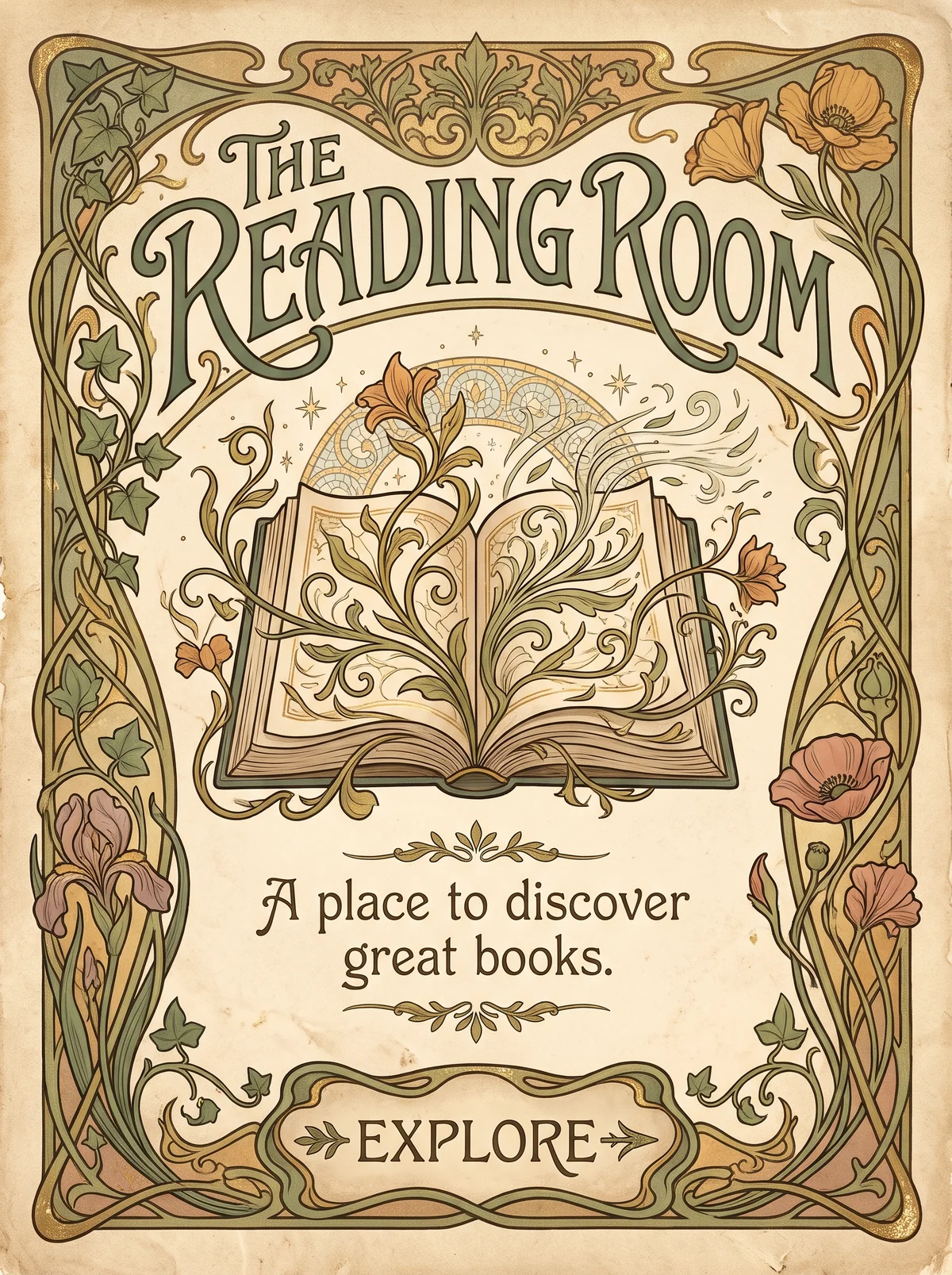
Poster on aged paper framed by flowing vines, irises, and poppies in sage, olive, and dusty rose. "The Reading Room" in hand-drawn, curving lettering arched across the top. In the center, an open book overgrown with stylized plants and flowers, with a decorative halo behind it. Below, the tagline "A place to discover great books." in flowing script. At the bottom, an ornamental cartouche reading "Explore" with an arrow.
The Reading Room in Art Nouveau. An interpretation of the shared “The Reading Room” brief, not a historical work. Supplied by Ryan Grissinger.

Philosophy

Art should be part of everyday life. Natural forms and flowing lines unify architecture, objects, and graphics.

Historical context

Origins
Europe: Brussels, Paris, Vienna, Glasgow, Barcelona, and Munich.
Period
c. 1890–1910
Influences
Arts and Crafts, Japanese woodblock prints, Natural forms, Gothic
Notable figures
Alphonse Mucha, Victor Horta, Hector Guimard, Charles Rennie Mackintosh, Antoni Gaudí, Louis Comfort Tiffany

Drafted from general design history. Sources pending.

What the example shows

Observations tied to the taxonomy, including where the example departs from the profile.

  • 02 · Typography

    Hand-drawn lettering whose forms bend to follow the arch of the frame. Type and ornament are inseparable.

  • 04 · Line & Borders

    Whiplash vines and stems form a continuous frame around the whole page.

  • 13 · Imagery & Illustration

    The book is overgrown with plants. Image and decoration are the same thing.

  • 01 · Color

    Sage, olive, ochre, and dusty rose drawn from nature.

  • 05 · Texture & Material

    Paper grain and staining suggest a printed lithograph poster.

Often confused with

The styles closest to Art Nouveau, and what sets each apart.

Art Deco

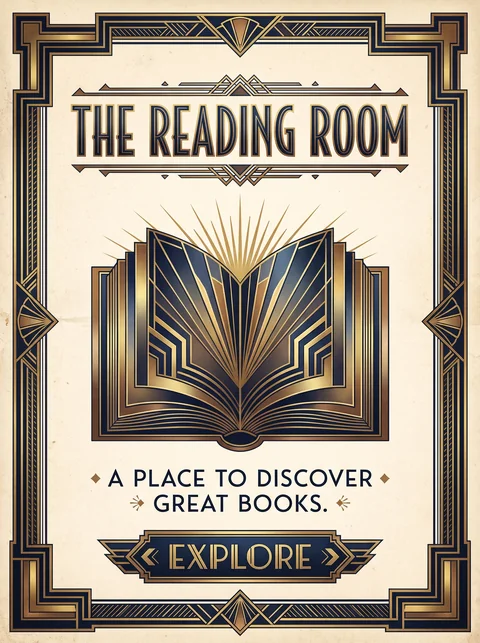
Art Nouveau flows in organic curves drawn from plants; Art Deco, which followed it, turns ornament geometric, with chevrons, sunbursts, and stepped forms.

03 · Shape & Geometry
Art Nouveau Organic: whiplash curves, stems, and flowers.
Art Deco Geometric: chevrons, sunbursts, and stepped forms.
09 · Balance & Tension
Art Nouveau Asymmetric, flowing arrangements.
Art Deco Strict symmetry.
02 · Typography
Art Nouveau Hand-drawn lettering that curves with the design.
Art Deco Tall, condensed geometric capitals.
01 · Color
Art Nouveau Muted greens, ochres, and soft pastels.
Art Deco Black, gold, and metallic contrast.
20 · Historical & Cultural References
Art Nouveau About 1890 to 1910, drawing on nature.
Art Deco The 1920s and 1930s, celebrating the machine age.
View Art Deco

Arts and Crafts

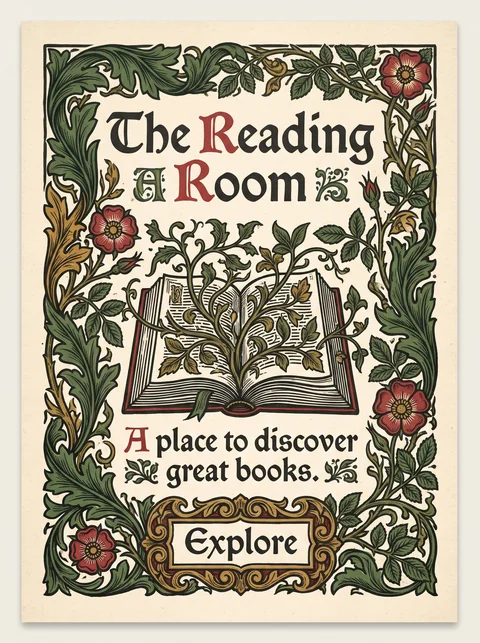
Both draw on nature, but Arts and Crafts is a moral movement about handmade work and honest materials, while Art Nouveau is a decorative style of sinuous, stylized line.

04 · Line & Borders
Art Nouveau Long, whiplash curves.
Arts and Crafts Firm outlines in dense, repeating patterns.
14 · Ornamentation
Art Nouveau Ornament flows across the whole surface, asymmetrically.
Arts and Crafts Symmetrical, tightly repeating botanical pattern.
05 · Texture & Material
Art Nouveau Smooth lithographic color.
Arts and Crafts The texture of woodblock, hand printing, and woven cloth.
19 · Mood & Personality
Art Nouveau Sensual and modern.
Arts and Crafts Earnest, medieval-minded, and handmade.
20 · Historical & Cultural References
Art Nouveau Continental Europe, about 1890 to 1910.
Arts and Crafts Britain from the 1860s, led by William Morris.
View Arts and Crafts

Psychedelic Design

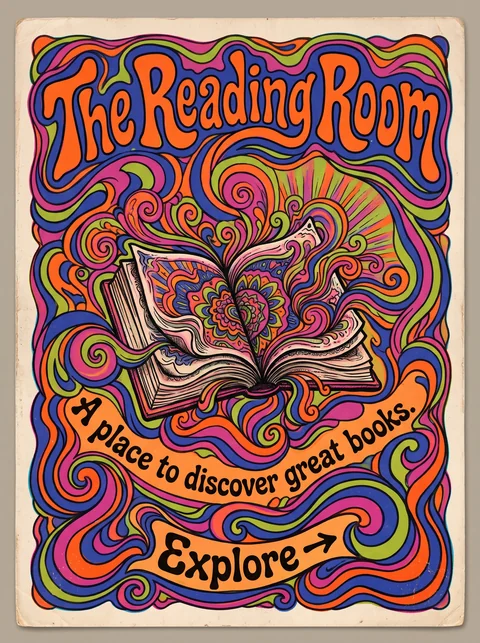
1960s psychedelic posters revived Art Nouveau's flowing lettering and curves, then pushed them into vibrating, clashing color and type at the edge of legibility.

01 · Color
Art Nouveau Muted, natural colors.
Psychedelic Design Saturated complementary colors that vibrate.
02 · Typography
Art Nouveau Decorative but readable lettering.
Psychedelic Design Lettering that melts to fill its shape.
07 · Space & Density
Art Nouveau Ornament with room to breathe.
Psychedelic Design Every space filled.
20 · Historical & Cultural References
Art Nouveau About 1890 to 1910.
Psychedelic Design San Francisco concert posters, mid to late 1960s.
View Psychedelic Design

Victorian

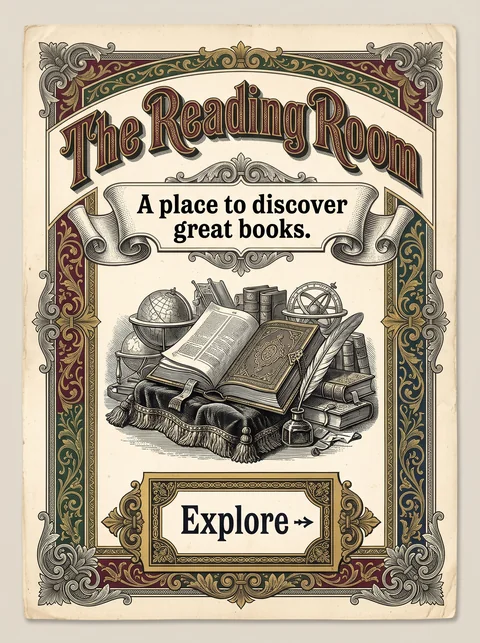
Victorian design stacks many historical ornaments on one page; Art Nouveau, emerging at the end of that era, replaces them with a single flowing line drawn from nature.

14 · Ornamentation
Art Nouveau One unified, organic ornamental language.
Victorian Eclectic revival ornament, often mixed.
02 · Typography
Art Nouveau Custom, curving hand lettering.
Victorian Many contrasting typefaces at once.
06 · Layout & Grid
Art Nouveau Flowing, asymmetric compositions.
Victorian Symmetrical, centered, framed layouts.
13 · Imagery & Illustration
Art Nouveau Stylized flat illustration, often of women and plants.
Victorian Detailed engravings with crosshatching.
View Victorian

Solarpunk

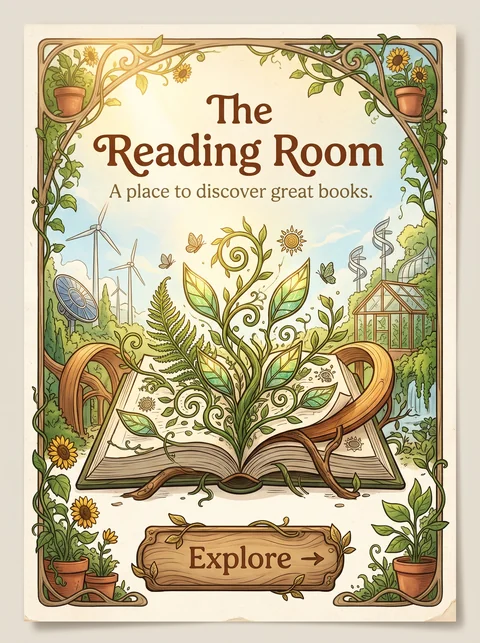
Solarpunk often borrows Art Nouveau's organic line but adds technology and a vision of the future; Art Nouveau is a historical style with no machines in its gardens.

13 · Imagery & Illustration
Art Nouveau Plants, flowers, and figures.
Solarpunk Plants alongside solar panels, wind turbines, and greenhouses.
01 · Color
Art Nouveau Muted ochres, greens, and pastels.
Solarpunk Bright leaf greens, golden light, and sky blue.
19 · Mood & Personality
Art Nouveau Decadent and sensual.
Solarpunk Hopeful, communal, and forward-looking.
20 · Historical & Cultural References
Art Nouveau About 1890 to 1910.
Solarpunk A 2010s and 2020s movement in fiction and design.
View Solarpunk

Comparisons are drafted from general design history and not yet checked against sources.

The style, layer by layer

Described with the Laboratory's shared vocabulary, from the elements up to digital behavior.

Foundation · fine art

The elements

Color
botanical muted earthy
Typography
decorative flowing hand lettered
Shape & geometry
organic curvilinear
Line & borders
ornamental whiplash continuous
Texture & material
illustrated textile
Imagery
illustrated pictorial
Ornamentation
elaborate

Graphic design adds

The principles

Layout & grid
framed symmetrical
Space & density
layered
Balance
harmonious
Rhythm
curvilinear
Hierarchy
decorative
Contrast
moderate

Web design adds

Digital expression

Dimensionality
layered
Motion
flowing
Interaction
graceful
Navigation
spatial

Across every layer

Mood and personality

organic ornamental romantic graceful

Building in this style

Advisory guidance for a web interface. A demonstration may interpret the style differently.

Do

  • Frame content with flowing botanical borders.
  • Use whiplash curves rather than straight lines.
  • Set headlines in custom decorative lettering.
  • Draw palettes from plants: olive, sage, ochre, rose.

Avoid

  • Hard geometric grids.
  • Neon or saturated digital colors.

Working palette

  • #F3EBD8

    Background

  • #2E2A1F

    Foreground

  • #7A8B3A

    Primary

  • #8C4A5A

    Secondary

  • #B8860B

    Accent

Headings
decorative display
Body
old style serif
Corner radius
12px
Borders
ornamental curvilinear

Accessibility

  • Decorative lettering must never carry body text or interface labels.

Responsive behavior

  • Simplify ornamental frames to corner motifs on small screens.

Sources

Sources pending. This profile was drafted from general design history and has not yet been checked against primary or scholarly sources.

π