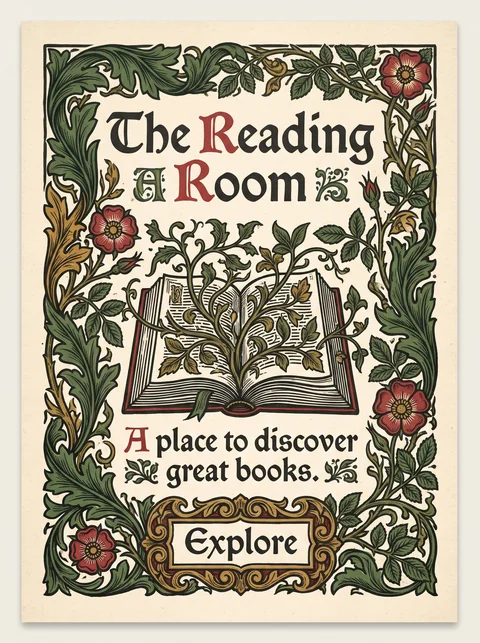
21 · Design movement · Victorian era 1837–1901

Victorian

Also known as Gothic Revival

Ornate, historical, dramatic

Draft profile · not yet reviewed against sources

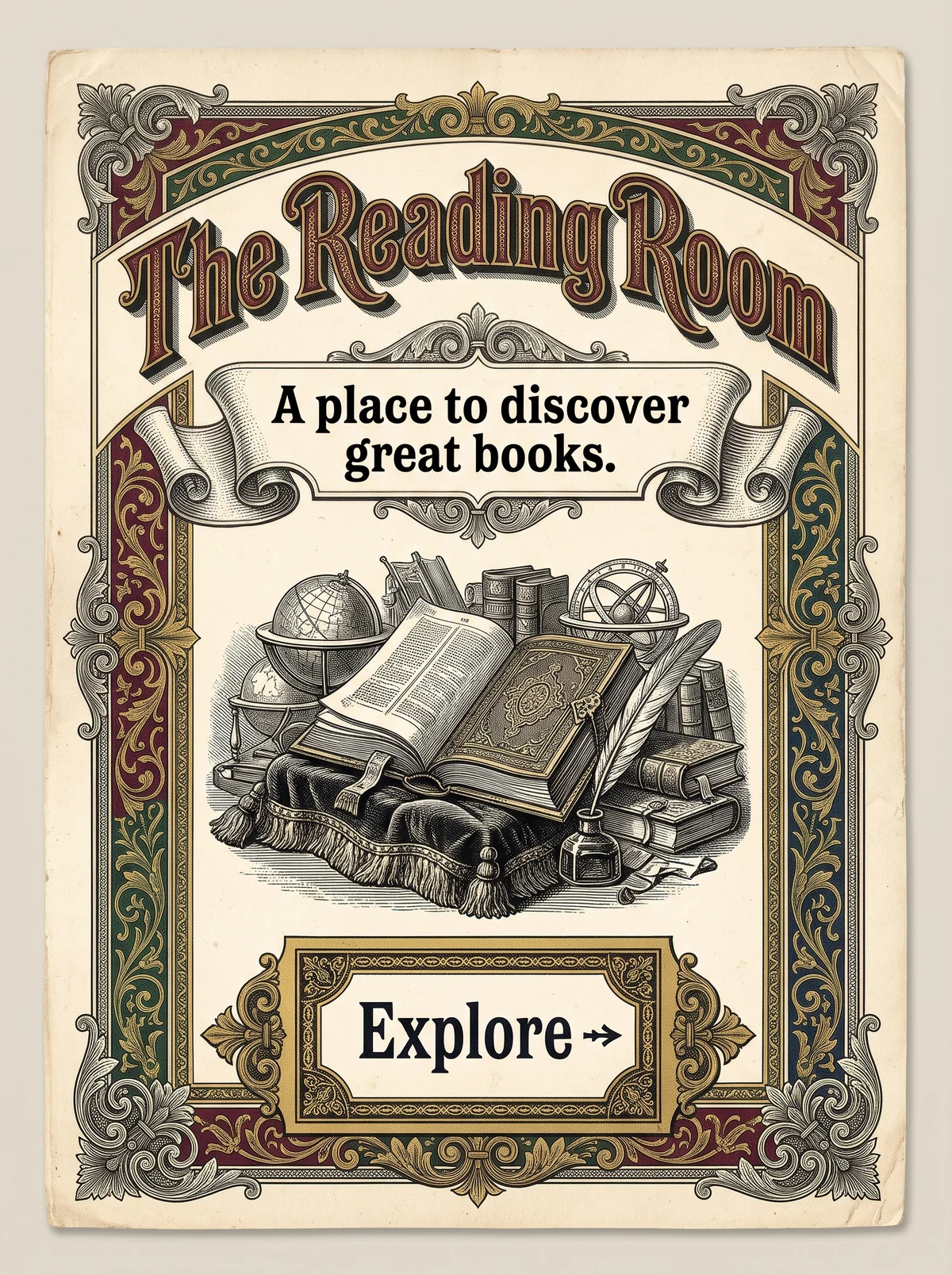
Cream aged-paper poster inside an ornate frame of burgundy, green, navy, and gold scrollwork with engraved corner pieces. At top, "The Reading Room" in arched, burgundy fat-face lettering with gold pattern fill and a drop shadow. Below it, a ribbon banner holds the tagline "A place to discover great books." in bold serif. In the center, an engraved scene of an open ornate book, two globes, an armillary sphere, stacked books, a quill, an inkwell, and a tasseled velvet cushion. At the bottom, a gold-framed ticket-style plaque labeled "Explore" with an arrow in dark serif.
The Reading Room in Victorian. An interpretation of the shared “The Reading Room” brief, not a historical work. Supplied by Ryan Grissinger.

Philosophy

Abundance and moral seriousness. Ornament demonstrates craft, prosperity, and connection to a medieval past.

Historical context

Origins
Britain and its empire; Gothic Revival architecture began earlier in the 18th century.
Period
Victorian era 1837–1901
Influences
Medieval Gothic architecture, Chromolithography, Wood type printing
Notable figures
Augustus Pugin, Owen Jones, Charles Barry, William Burges

Drafted from general design history. Sources pending.

What the example shows

Observations tied to the taxonomy, including where the example departs from the profile.

  • 14 · Ornamentation

    Filigree, scrollwork, engraved corners, and ribbon banners fill nearly every space, typical of Victorian printing.

  • 02 · Typography

    Several faces on one page: fat-face lettering with pattern fill, a bold serif tagline, and a clean serif for the button.

  • 13 · Imagery & Illustration

    A steel-engraving-style still life of books, globes, a quill, and an inkwell, with fine crosshatching.

  • 01 · Color

    Burgundy, green, navy, and gold on aged cream paper, rich and formal.

  • 17 · Interaction & Feedback

    The button is a printed ticket or plaque, in the spirit of ornamental Victorian labels.

Often confused with

The styles closest to Victorian, and what sets each apart.

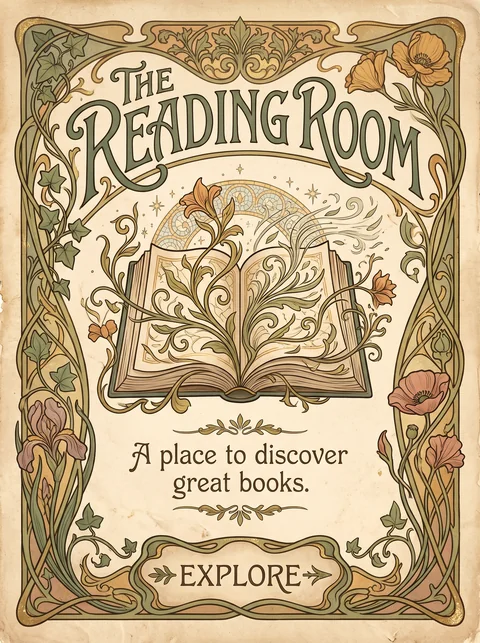
Art Nouveau

Victorian design stacks many historical ornaments on one page; Art Nouveau, emerging at the end of that era, replaces them with a single flowing line drawn from nature.

14 · Ornamentation
Victorian Eclectic revival ornament, often mixed.
Art Nouveau One unified, organic ornamental language.
02 · Typography
Victorian Many contrasting typefaces at once.
Art Nouveau Custom, curving hand lettering.
06 · Layout & Grid
Victorian Symmetrical, centered, framed layouts.
Art Nouveau Flowing, asymmetric compositions.
13 · Imagery & Illustration
Victorian Detailed engravings with crosshatching.
Art Nouveau Stylized flat illustration, often of women and plants.
View Art Nouveau

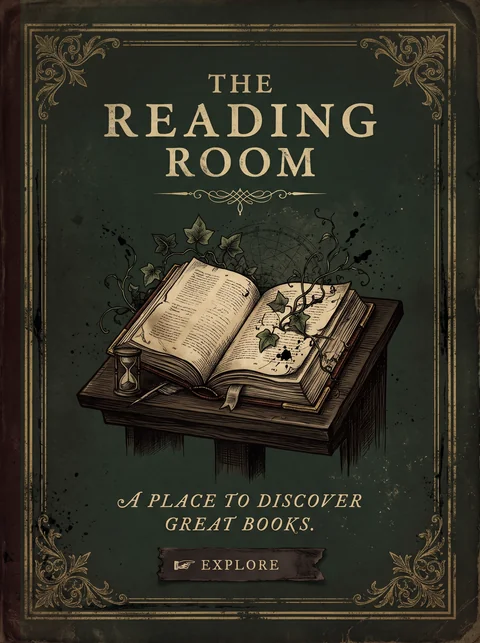
Dark Academia

Victorian design is a historical print style; Dark Academia is a late-2010s online aesthetic that borrows the look of old libraries and universities to set a moody, scholarly tone.

01 · Color
Victorian Rich, varied chromolithographic color on cream.
Dark Academia Dark browns, deep greens, and candlelit shadow.
14 · Ornamentation
Victorian Ornament fills every space.
Dark Academia Restrained; mood comes from imagery and texture.
13 · Imagery & Illustration
Victorian Engraved illustration.
Dark Academia Moody photography of books, stone, and tweed.
19 · Mood & Personality
Victorian Confident and showy.
Dark Academia Melancholic and introspective.
20 · Historical & Cultural References
Victorian Britain, 1837 to 1901.
Dark Academia An internet aesthetic from the late 2010s.
View Dark Academia

Arts and Crafts

Arts and Crafts was a reaction against Victorian design, rejecting cheap machine-made ornament in favor of honest handwork and restrained, nature-based pattern.

14 · Ornamentation
Victorian Mass-produced ornament from many historical styles at once.
Arts and Crafts Ornament from nature, drawn by hand.
02 · Typography
Victorian Many typefaces on one page: fat faces, slabs, and Tuscans.
Arts and Crafts Unified, book-like type inspired by early printing.
07 · Space & Density
Victorian Crowded; empty space gets filled.
Arts and Crafts Dense but orderly.
19 · Mood & Personality
Victorian Grand, eclectic, and commercial.
Arts and Crafts Honest and handmade.
View Arts and Crafts

Comparisons are drafted from general design history and not yet checked against sources.

The style, layer by layer

Described with the Laboratory's shared vocabulary, from the elements up to digital behavior.

Foundation · fine art

The elements

Color
deep rich jewel toned
Typography
ornamental wood type mixed
Shape & geometry
pointed arches traditional
Line & borders
ornamental framed
Texture & material
engraved embossed
Imagery
engraved
Ornamentation
maximalist

Graphic design adds

The principles

Layout & grid
symmetrical framed
Space & density
dense
Balance
stable
Rhythm
repetitive
Hierarchy
dramatic
Contrast
rich

Web design adds

Digital expression

Dimensionality
embossed
Motion
minimal
Interaction
formal
Navigation
hierarchical

Across every layer

Mood and personality

ornate historical dramatic formal

Building in this style

Advisory guidance for a web interface. A demonstration may interpret the style differently.

Do

  • Frame everything in ornamental borders.
  • Mix several display typefaces, as playbills did.
  • Use deep oxblood, forest green, and gold.
  • Prefer engraving-style illustration.

Avoid

  • Flat minimalism.
  • Bright synthetic colors.

Working palette

  • #EFE6D2

    Background

  • #1E1A16

    Foreground

  • #6E1423

    Primary

  • #1F3B2D

    Secondary

  • #B08D57

    Accent

Headings
ornamental display serif
Body
old style serif
Corner radius
0px
Borders
ornamental frame

Accessibility

  • Mixed display faces must not carry body text; keep one readable text face.

Responsive behavior

  • Reduce frames to simple rules on small screens.

Sources

Sources pending. This profile was drafted from general design history and has not yet been checked against primary or scholarly sources.

π