17 · Design movement · c. 1860–1920

Arts and Crafts

Handmade, warm, intentional

Draft profile · not yet reviewed against sources

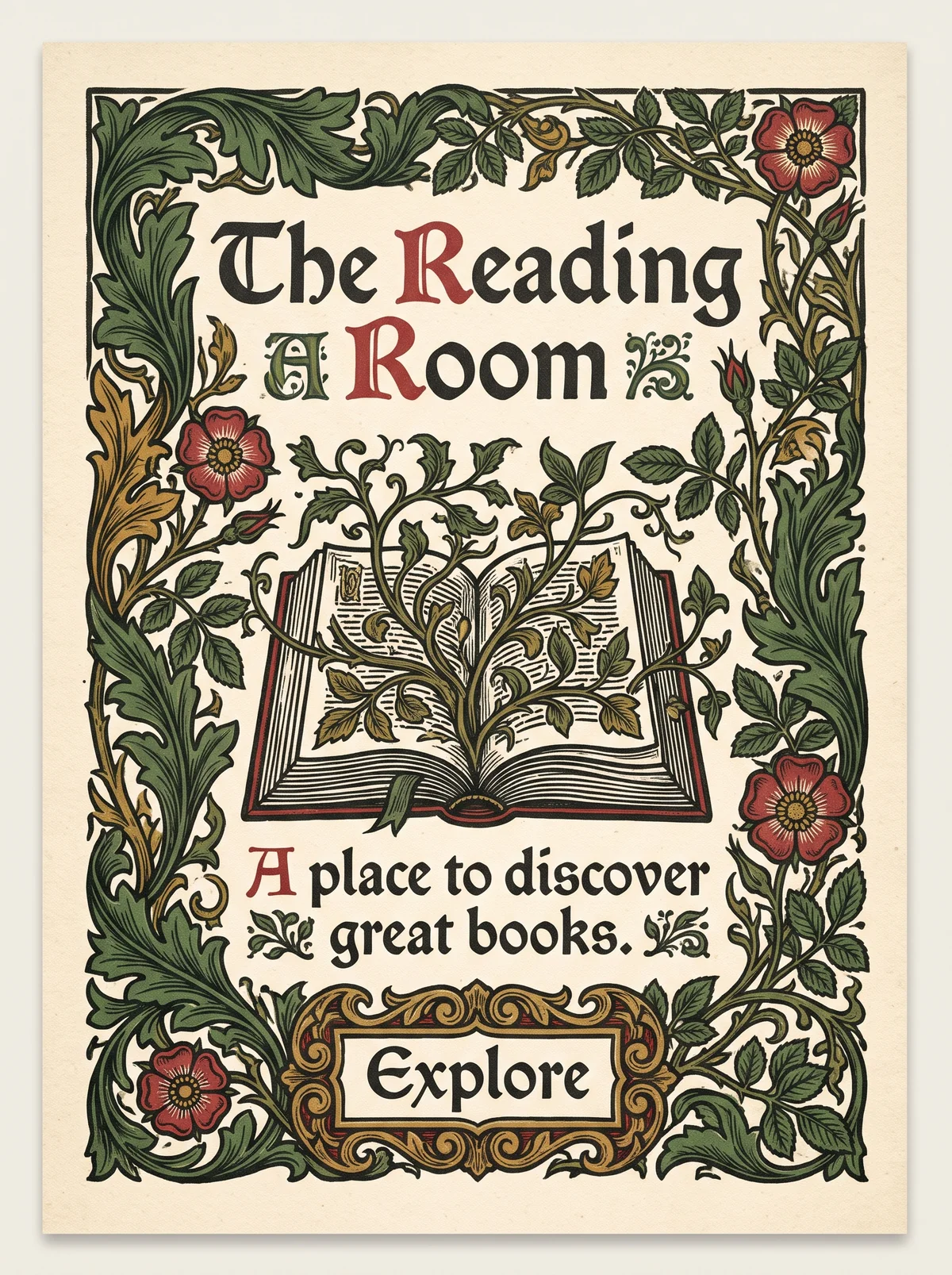
Woodblock-style poster on cream paper inside a dense border of green acanthus leaves, climbing vines, and red wild roses with gold centers. At top, "The Reading Room" in black blackletter-inspired capitals, with the R's in red and a small ornamented A beside "Room". In the center, an open book with a vine growing from its spine, its leaves spilling over the pages. Below, the tagline "A place to discover great books." with a red initial A and small leaf ornaments on either side. At bottom, a button labeled "Explore" inside a gold and red scrolled cartouche.
The Reading Room in Arts and Crafts. An interpretation of the shared “The Reading Room” brief, not a historical work. Supplied by Ryan Grissinger.

Philosophy

A reaction against industrial mass production. Honest materials, handcraft, and the dignity of the maker.

Historical context

Origins
Britain, later the United States.
Period
c. 1860–1920
Influences
Medieval craft, Gothic Revival, John Ruskin's writing
Notable figures
William Morris, C. R. Ashbee, Charles Voysey, Philip Webb, Gustav Stickley

Drafted from general design history. Sources pending.

What the example shows

Observations tied to the taxonomy, including where the example departs from the profile.

  • 14 · Ornamentation

    Ornament is the structure. A continuous border of acanthus, vines, and wild roses frames the page, in the spirit of William Morris.

  • 13 · Imagery & Illustration

    The book is not a symbol on a page. A living vine grows out of its spine, tying the object to nature and handcraft.

  • 02 · Typography

    A chunky, hand-drawn letterform with medieval roots. Red initial capitals nod to illuminated manuscripts and Kelmscott-style book design.

  • 05 · Texture & Material

    Ink lines have the slight irregularity of a woodblock or linocut print, on warm uneven paper. The surface shows the hand.

  • 01 · Color

    Earthy and limited: forest green, madder red, ochre, and black on cream. The colors read as natural dyes and pigments.

  • 09 · Balance & Tension

    Symmetrical and enclosed. Text, image, and button stack down a central axis inside the frame, like a book page.

Often confused with

The styles closest to Arts and Crafts, and what sets each apart.

Art Nouveau

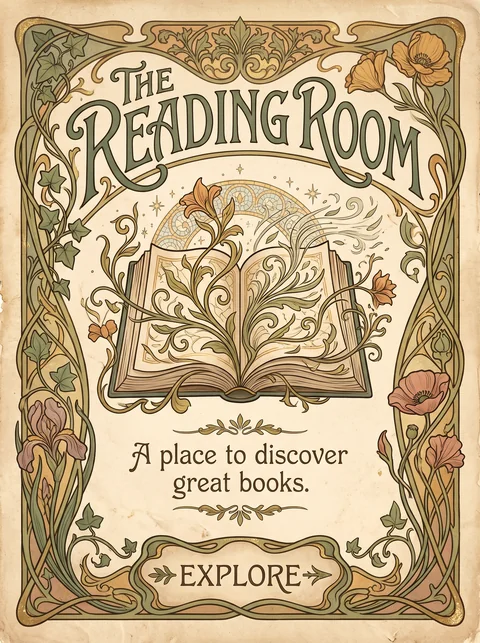
Both draw on nature, but Arts and Crafts is a moral movement about handmade work and honest materials, while Art Nouveau is a decorative style of sinuous, stylized line.

04 · Line & Borders
Arts and Crafts Firm outlines in dense, repeating patterns.
Art Nouveau Long, whiplash curves.
14 · Ornamentation
Arts and Crafts Symmetrical, tightly repeating botanical pattern.
Art Nouveau Ornament flows across the whole surface, asymmetrically.
05 · Texture & Material
Arts and Crafts The texture of woodblock, hand printing, and woven cloth.
Art Nouveau Smooth lithographic color.
19 · Mood & Personality
Arts and Crafts Earnest, medieval-minded, and handmade.
Art Nouveau Sensual and modern.
20 · Historical & Cultural References
Arts and Crafts Britain from the 1860s, led by William Morris.
Art Nouveau Continental Europe, about 1890 to 1910.
View Art Nouveau

Victorian

Arts and Crafts was a reaction against Victorian design, rejecting cheap machine-made ornament in favor of honest handwork and restrained, nature-based pattern.

14 · Ornamentation
Arts and Crafts Ornament from nature, drawn by hand.
Victorian Mass-produced ornament from many historical styles at once.
02 · Typography
Arts and Crafts Unified, book-like type inspired by early printing.
Victorian Many typefaces on one page: fat faces, slabs, and Tuscans.
07 · Space & Density
Arts and Crafts Dense but orderly.
Victorian Crowded; empty space gets filled.
19 · Mood & Personality
Arts and Crafts Honest and handmade.
Victorian Grand, eclectic, and commercial.
View Victorian

Comparisons are drafted from general design history and not yet checked against sources.

The style, layer by layer

Described with the Laboratory's shared vocabulary, from the elements up to digital behavior.

Foundation · fine art

The elements

Color
earthy natural muted
Typography
old style serif woodcut
Shape & geometry
organic botanical
Line & borders
hand drawn woodcut
Texture & material
paper wood textile
Imagery
woodcut illustrated
Ornamentation
elaborate

Graphic design adds

The principles

Layout & grid
symmetrical framed
Space & density
dense patterned
Balance
stable
Rhythm
repetitive patterned
Hierarchy
traditional
Contrast
moderate

Web design adds

Digital expression

Dimensionality
flat textured
Motion
minimal
Interaction
understated
Navigation
linear

Across every layer

Mood and personality

handmade warm intentional honest

Building in this style

Advisory guidance for a web interface. A demonstration may interpret the style differently.

Do

  • Use repeating botanical patterns as backgrounds and borders.
  • Set type in old-style serifs with woodcut initials.
  • Show the hand: slightly irregular lines and textures.
  • Draw colors from plant dyes.

Avoid

  • Glossy or synthetic surfaces.
  • Neon colors.
  • Machine-perfect geometry.

Working palette

  • #F1E8D4

    Background

  • #2D2A22

    Foreground

  • #5B6E3A

    Primary

  • #8B3A2B

    Secondary

  • #C49A3A

    Accent

Headings
old style serif
Body
old style serif
Corner radius
0px
Borders
woodcut ornamental

Accessibility

  • Busy pattern backgrounds must sit behind solid text panels.

Responsive behavior

  • Scale patterns down rather than removing them; they define the style.

Sources

Sources pending. This profile was drafted from general design history and has not yet been checked against primary or scholarly sources.

π